Do Hippos Feed the Sea?
Bijagós Archipelago · Guinea-Bissau · 2027
There are places where the line between land and sea is never quite fixed.
In the Bijagós Archipelago, tides move deep into mangrove forests, channels appear and disappear, and islands sit scattered across a vast shallow sea.
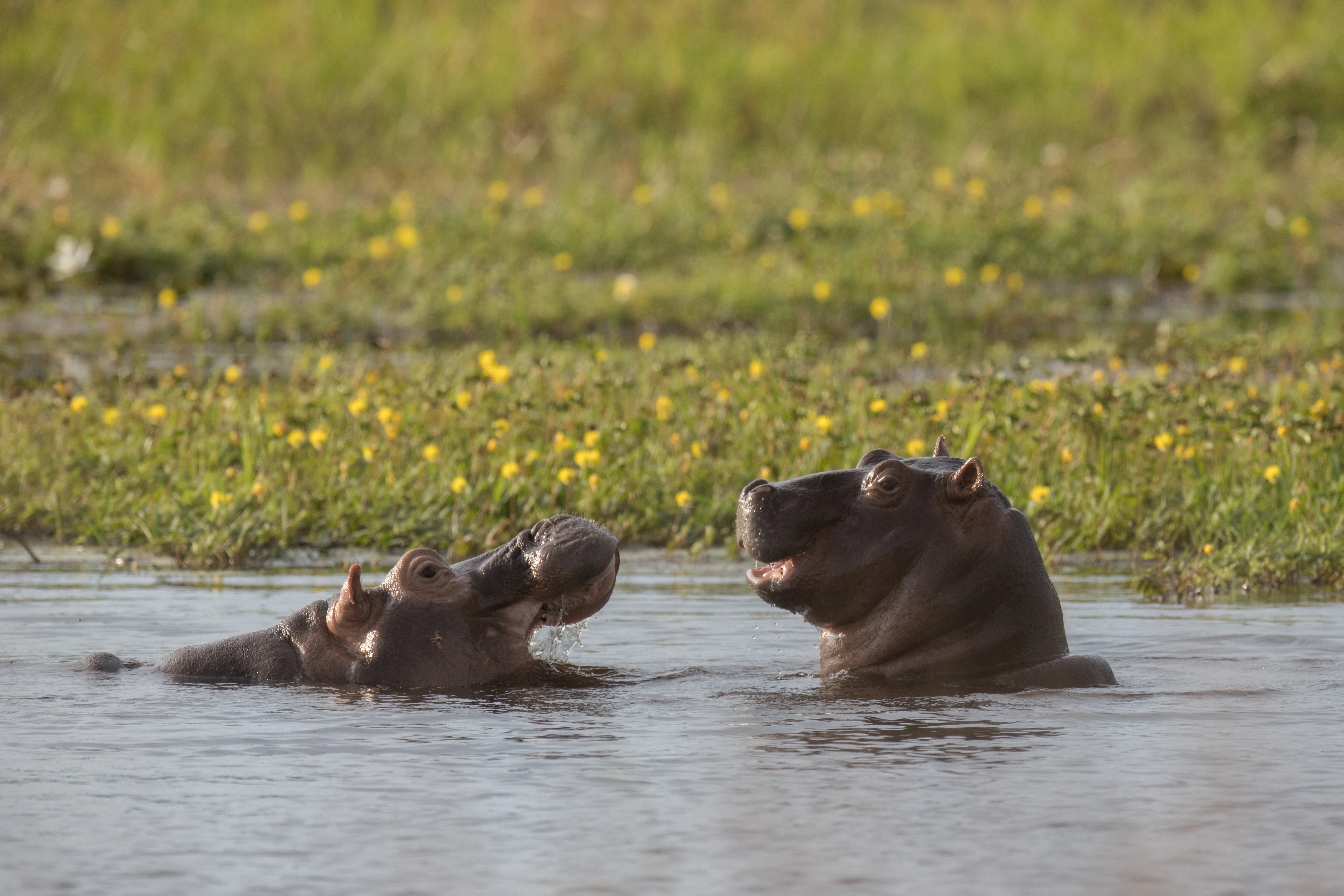
On Orango, even the hippos cross that line.
They feed on land and spend time in freshwater lagoons, but they also move through mangroves and tidal areas and venture into the sea.
That was the detail that stayed with us.
Following a connection
Hippos can move enormous amounts of nutrients through an ecosystem. What they eat in one place does not necessarily stay there.
So what happens on an island where their world does not end at the edge of a river or lake?
Could some of what begins on land travel with them towards the mangroves and the coast? Could an animal we usually think of as terrestrial be part of a much larger connection between land and sea?
In 2027, we are taking that question to Orango.
Working with scientists and local researchers, the expedition will follow these connections through the landscapes the hippos use, from inland areas and freshwater to mangroves and the coast.
We don't yet know what we will find.
Maybe the signal reaches the sea. Maybe it stops much earlier.
Both answers matter.
Getting there is part of the work
Research in the Bijagós does not begin when the first sample is collected.
It begins with getting people, equipment and a boat into an archipelago of shifting tides, shallow channels, mangroves and remote islands. It means planning around water, weather and distance, carrying what the team needs, and adapting when the landscape changes the plan.
Then there are the animals themselves.
Working in hippo territory demands distance, patience and respect. These are powerful wild animals moving through a landscape that belongs to them, not to us. Fieldwork has to follow their movements without interfering with them, and safety shapes where, when and how the team can work.
Some sites may be reached from the sea. Others may mean moving by small boat through tidal channels and continuing on foot with local researchers who know the terrain.
Sometimes the only way to understand a place is to go into it.
A landscape people live by
Orango is not an empty wilderness.
People have lived across the Bijagós for generations, in communities shaped by islands, tides and seasons, but also by social structures, beliefs and traditions very different from our own. Some forests, beaches and islands carry meanings that cannot be read from a chart. Stories, rituals and rules passed between generations still influence how places are entered, used and protected.
For an expedition coming from outside, understanding where we are also means knowing when not to enter, when to listen, and who to ask.
The scientific story is only one way of reading this landscape. The people who live here have another.
An expedition built around a place
For weeks, Mirabo will become more than a way of getting there.
The boat will be a moving field base: carrying the team and equipment, connecting sampling locations, providing a place to live and work, and allowing us to stay close to areas that would otherwise be difficult to reach.
But the expedition cannot be organised from the deck of a yacht alone.
Scientists studying hippos, nutrients and coastal ecosystems are working alongside researchers with direct knowledge of the Bijagós. Local coordination, permissions, field knowledge and an understanding of Orango itself are as important as anything we bring aboard.
Because out here, a line drawn on a map tells you very little about what it will take to cross it.
One expedition. A much bigger story.
The question begins with hippos.
But following them takes us into something larger: mangroves and tides, freshwater and ocean, animal movement and nutrient movement, local knowledge and scientific evidence.
And somewhere between all of those things is the reason for going.
Not to prove that we already know the answer.
To get close enough to find out.
Bijagós Research Expedition · 2027
Image credits: Joehawkins / Wikimedia Commons.